
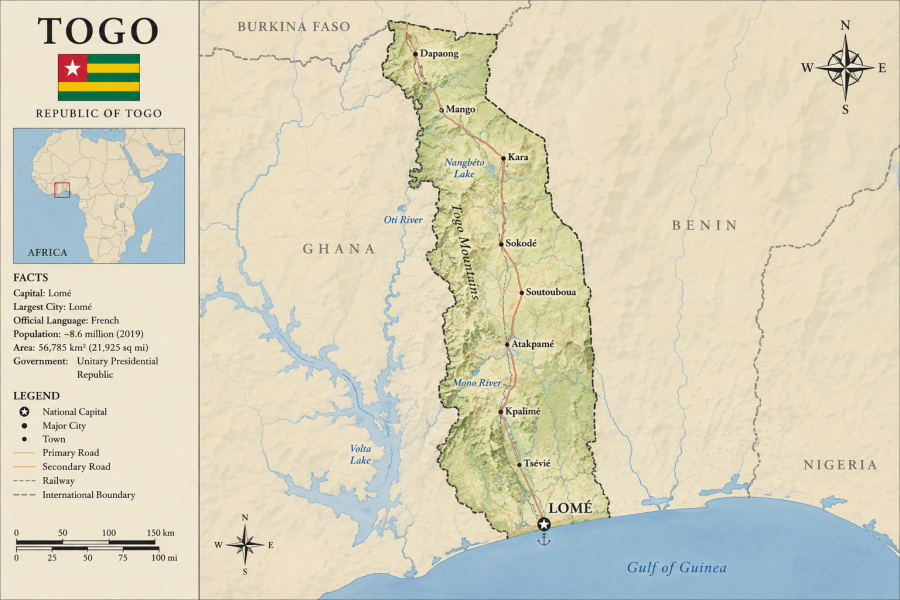
On 17 November 2019, as Russian expeditionary forces consolidated their occupation of Tanzania, fighting spread quietly into a second theater far from the world's attention.
The first shots of the West African Campaign were not fired by NATO troops, African Union peacekeepers, or Russian regulars. They came instead during a nighttime raid outside Lomé, where Togolese security forces clashed with unidentified operators attempting to seize communications infrastructure linking the coast to the interior.
For most observers, the incident barely registered. International attention remained fixed on East Africa, where the assassination of Demi Lovato on the Maasai Mara and the subsequent Russian intervention in Tanzania had already shattered assumptions about the permanence of the post-Cold War order.
Yet, in retrospect, November 2019 marked the moment when the conflict ceased to be a regional crisis and became something larger: a continental war.
By the end of that month, Russian personnel, advisers, contractors, and autonomous systems had appeared across multiple African states. Officially, Moscow described these deployments as counterterrorism partnerships and stabilization missions requested by sovereign governments threatened by insurgency and state failure.
Unofficially, they represented the opening phase of a coordinated effort to dominate critical infrastructure, resource corridors, ports, and communication networks stretching from the Indian Ocean to the Gulf of Guinea.
In Togo, President Faure Gnassingbé welcomed Russian assistance as a pragmatic response to growing insecurity across West Africa. The Sahel insurgencies had pushed steadily southward. Western governments appeared distracted and increasingly unwilling to commit resources. Russian offers arrived with few conditions attached.
Moscow promised advanced weapons, military advisers, investment capital, satellite support, and security guarantees.
For governments facing immediate threats, such promises proved difficult to refuse.
The consequences would extend far beyond Togo.
Unlike the colonial campaigns of earlier centuries, the struggle for Africa in the twenty-first century was driven not by formal empire but by control over systems: ports, rare-earth deposits, undersea cables, launch facilities, logistics hubs, energy corridors, and data networks.
Africa was not a peripheral theater.
It was the center of gravity.
The technologies deployed reflected that reality. Autonomous reconnaissance swarms mapped terrain in real time. Mass-driver artillery struck targets hundreds of miles away. Lasertanks engaged enemy drones across horizons invisible to their crews. BEMP rifles disrupted electronics and nervous systems alike. Artificial intelligence systems coordinated operations faster than human commanders could comprehend.
Yet for all its technological sophistication, the war ultimately depended on familiar realities: roads, fuel, food, water, and people.
Millions of Africans who had no connection to the assassination found themselves caught between competing powers struggling for control of a continent already strained by climate shocks, demographic pressure, and fragile infrastructure.
As the conflict expanded, governments outside the war zone reassured themselves that the fighting would remain contained.
That illusion ended on 14 March 2020.
On that day, the civilian evacuation liner Mombasa Star departed Dar es Salaam carrying more than four thousand passengers: refugees, aid workers, journalists, medical personnel, and foreign nationals from thirty-two countries.
Two days later, the ship disappeared in the Mozambique Channel.
Initial reports blamed mechanical failure.
Subsequent investigations suggested otherwise.
Fragments recovered from the wreckage pointed to an autonomous underwater munition linked to Russian naval operations.
The sinking transformed global opinion overnight.
Countries that had remained neutral could no longer regard the war as a distant African crisis. Demonstrations erupted across Europe, North America, Australia, and Latin America. Russian embassies faced protests. Volunteer recruitment surged. Sanctions intensified.
Like the Lusitania more than a century earlier, the loss of the Mombasa Star became a symbol of the moment when a regional conflict revealed its global implications.
From that point forward, no government could plausibly claim that the war in Africa belonged only to Africa.
It belonged to the world.
What followed would reshape continents, alter climates, redraw borders, and transform the relationship between humanity and its own technologies.
This volume tells the story of those campaigns.
Not the diplomacy that followed.
Not the reconstruction that emerged.
But the war itself: the forgotten offensives, the improvised alliances, the soldiers who fought across deserts, forests, coastlines, and ruined cities, and the millions of Africans whose lives were irrevocably changed by a conflict they did not begin.
World War DL began with a murder on the Maasai Mara.
Its consequences spread everywhere.
Here's a revised version that shifts the focus away from colonial anxieties and toward the distinctive dynamics of the WWDL setting: technological asymmetry, great-power competition, information control, and the central role of African populations in a war they neither initiated nor controlled.
The central fear among political leaders across Africa in late 2019 was not the collapse of racial hierarchies but the collapse of sovereignty itself.
For decades, governments had balanced fragile internal coalitions against external pressures: insurgencies in the Sahel, resource competition, climate stress, demographic expansion, and the uneven reach of infrastructure across vast territories. The arrival of Russian expeditionary forces introduced a new and destabilizing variable.
States feared that the continent would once again become a theater in which external powers pursued strategic objectives largely indifferent to local consequences.
The danger was twofold.
First, the deployment of advanced autonomous systems threatened to reduce national governments to spectators within their own borders. Lasertanks, reconnaissance swarms, mass-driver artillery, and artificial-intelligence command networks operated at speeds and scales that many African militaries could neither match nor effectively counter.
Second, the conflict accelerated the militarization of populations already living under conditions of chronic insecurity. Communities that had previously relied on local defense groups, police forces, or informal security arrangements found themselves drawn into a war defined by technologies they scarcely understood.
As in earlier eras, the consequences extended far beyond the battlefield.
The conflict did not revive traditional political structures so much as disrupt them. Existing networks of authority—local, regional, and national—were strained by displacement, resource scarcity, and the demands of mobilization. New elites emerged from the war: logistics coordinators, drone technicians, data specialists, militia leaders, aid organizers, and those capable of navigating the increasingly fragmented systems upon which survival depended.
The social transformations unleashed by the war would long outlast the fighting itself.
Although World War DL originated in the decisions of distant capitals and was triggered by the assassination of a global cultural figure, it was fought primarily by external powers on African soil.
Russian expeditionary forces, European coalition units, private military contractors, autonomous systems, and foreign volunteers transformed the continent into the central theater of a war whose strategic objectives were largely determined elsewhere.
African states participated in the conflict in varying ways. Some governments aligned with Moscow. Others cooperated with Western coalitions. National militaries, regional security forces, and local defense organizations fought to preserve their sovereignty amid rapidly shifting alliances and collapsing infrastructure.
Yet most Africans were not participants in the geopolitical struggle that engulfed their continent.
They were its unwilling witnesses and principal victims.
Millions found themselves trapped between competing powers struggling for control of territory, resources, ports, communication networks, and strategic corridors. Entire communities were displaced by offensives they neither initiated nor influenced. Farmers, traders, medical workers, teachers, and local officials became casualties of decisions made thousands of miles away.
Precise casualty figures remain impossible to establish.
Archives disappeared. Population records were lost. Communication systems failed. In some regions, no functioning institutions remained capable of documenting the dead.
Throughout the conflict and long after its conclusion, competing powers accused one another of militarizing Africa.
Russian officials portrayed their deployments as legitimate security partnerships requested by sovereign governments confronting insurgency, piracy, and state fragmentation. Western governments countered that Moscow had transformed local crises into opportunities for strategic expansion, embedding advisers, contractors, and autonomous systems within fragile states ill-equipped to resist external pressure.
Both narratives contained elements of truth.
Both obscured a deeper reality.
The militarization of Africa did not begin with the arrival of Russian expeditionary forces in late 2019. Long before the assassination on the Maasai Mara, the continent had become increasingly entangled in global competition over resources, infrastructure, migration routes, communications networks, and maritime chokepoints.
What changed after November 2019 was the scale, speed, and technological sophistication of that competition.
Advanced weapons systems arrived under the language of stabilization.
Autonomous reconnaissance swarms were deployed to monitor insurgent activity.
Mass-driver batteries were installed to protect strategic ports.
Lasertank units secured resource corridors.
Artificial-intelligence command networks promised greater efficiency and precision.
Each deployment was presented as temporary.
Few remained so.
As the conflict expanded, local security forces found themselves integrated into larger military architectures designed elsewhere and for purposes only partially aligned with their own.
National armies increasingly depended upon foreign satellite networks, imported autonomous systems, and external logistical support. Tactical decisions made in Lomé, Nairobi, Dar es Salaam, or Abuja often reflected strategic calculations originating in Moscow, Brussels, London, Paris, or Washington.
The distinction between assistance and dependency gradually eroded.
Yet it would be a mistake to conclude that African societies themselves drove this militarization.
They did not.
The principal combatants were external powers.
The principal victims were African civilians.
Although local militaries participated extensively in the fighting, they did so under extraordinary pressure, confronting threats that frequently exceeded their technological and economic capacity.
Many governments faced impossible choices.
To reject foreign support risked isolation and vulnerability.
To accept it invited entanglement in a widening conflict whose objectives increasingly lay beyond national control.
As infrastructure failed and front lines shifted, civilian institutions assumed responsibilities for which they had never been designed.
Medical personnel operated within active combat zones.
Teachers became refugee coordinators.
Local officials managed population movements on a scale previously associated with natural disasters.
Community organizations evolved into improvised logistics networks.
Throughout the war, ordinary Africans adapted repeatedly to circumstances imposed upon them by forces beyond their control.
The resulting social transformations would outlast the conflict itself.
The war altered migration patterns, accelerated urbanization, disrupted traditional structures of authority, and produced new political and economic elites whose influence derived not from inherited status but from their ability to navigate fractured systems.
By the time the fighting ended, Africa had become not merely the site of the war's greatest destruction but the place where the contradictions of twenty-first-century globalization were most visible.
The continent had not chosen to become the center of gravity in a global conflict.
It became that center because external powers concluded that control over Africa's territory, resources, infrastructure, and populations would determine the shape of the postwar world.
The war revealed the cost of that assumption.
Africans did not start World War DL.
But they paid for it more dearly than anyone else.92Please respect copyright.PENANAgmgY1cnxga
92Please respect copyright.PENANAN7xbVotIcu
92Please respect copyright.PENANAzIiWTpXkH5
92Please respect copyright.PENANAGdyLg9NDiZ
Although the twenty-first century had brought advanced aircraft, autonomous cargo systems, jetpack-equipped infantry, and sophisticated military vehicles to the battlefield, Central Africa remained one of the most difficult logistical environments on Earth. Outside major urban corridors, roads were often poor or nonexistent, rail construction lagged far behind demand, and vast stretches of jungle, swamp, and broken highland terrain limited the movement of heavy equipment. Aircraft alleviated some of these problems but could not eliminate them. Laser tanks, mass-driver batteries, BEMP-equipped infantry formations, and drone units consumed enormous quantities of fuel, spare parts, ammunition, and power cells. Every advance required a continuous flow of supplies from rear-area depots hundreds of kilometers away.
During World War DL, planners on both sides discovered that sustaining a modern mechanized force in Central Africa demanded far more logistical support than prewar doctrine had anticipated. Strategic airlifters, cargo helicopters, tilt-rotor transports, and autonomous supply convoys operated constantly between major bases in Kenya, Uganda, Rwanda, Tanzania, Cameroon, and the Democratic Republic of the Congo. Even so, shortages remained common, and entire offensives were frequently dictated not by combat losses but by the ability to move energy cells, replacement components, and maintenance teams forward through some of the most difficult terrain in the world.
The logistical burden imposed by the African theatre proved no less demanding than that borne by the armies of France during the First World War. NATO and Russian planners entered the conflict expecting rapid maneuver operations supported by advanced transportation networks, autonomous cargo systems, strategic airlift, and orbital reconnaissance. Instead, they discovered that the sheer scale of the continent consumed personnel and materiel at a rate few had anticipated. Every laser tank required maintenance crews and replacement optics. Every mass-driver battery consumed vast quantities of ammunition and power modules. BEMP-equipped infantry formations demanded a constant flow of charged energy cells, replacement components, communications equipment, and medical supplies. Aircraft and jetpack units extended operational reach but multiplied fuel and maintenance requirements.
By the third year of the war, support personnel outnumbered frontline combat troops by several multiples on both sides. With much of Europe struggling to survive the effects of the nanolocust outbreaks, NATO logistics commands increasingly relied on personnel from the United States, Canada, Australia, New Zealand, and surviving allied territories overseas. Russia did the same throughout its sphere of influence. Vast support complexes emerged across Kenya, Uganda, Rwanda, Tanzania, Cameroon, and the Congo Basin. Entire populations found themselves engaged in the war effort—not as carriers hauling supplies through the jungle, but as contractors, technicians, laborers, drivers, engineers, and maintenance personnel struggling to keep the machinery of modern warfare functioning.
Terrain remained a relentless enemy. Dense equatorial forests interfered with satellite observation and long-range communications. Seasonal rains rendered roads impassable. Airfields required constant repair. Drone networks suffered heavy attrition from weather and combat losses. Jetpack-equipped troops could cross escarpments and ravines inaccessible to conventional forces, but they could not transport heavy weapons or sustain major formations. Strategic airlift alleviated some problems but could not eliminate them. Operational success increasingly depended not upon battlefield brilliance but upon the ability to move supplies, fuel, energy cells, spare parts, and replacement personnel to the front faster than the enemy.
What emerged was not the swift technological war predicted before the conflict, but a war of attrition fought across an entire continent. The weapons were more advanced than those of 1914, yet the underlying reality remained remarkably similar: armies advanced only as far as their logistics allowed; disease remained one of the principal enemies of both NATO and Russian forces. Advanced medical scanners, autonomous casualty evacuation systems, battlefield nanomedicine, and rapid-response air ambulances dramatically reduced mortality rates compared to earlier wars; they could not eliminate the effects of tropical disease, contaminated water supplies, heat injury, exhaustion, or prolonged exposure in remote environments. Soldiers incapacitated by malaria variants, hemorrhagic fevers, parasitic infections, and antibiotic-resistant pathogens frequently outnumbered those wounded in combat. Entire formations could see operational readiness collapse without firing a shot.
The problem was compounded by the immense logistical burden required to sustain modern armies. Every laser tank demanded replacement optics and power modules. Every mass-driver battery required enormous quantities of ammunition and maintenance components. BEMP rifles consumed energy cells that had to be continuously recharged or replaced. Drone fleets suffered constant attrition from weather, mechanical failures, electronic warfare, and combat losses. The farther a unit advanced into Central Africa, the greater the proportion of transport assets devoted merely to sustaining the supply network itself.
As a result, operational planners discovered that technology had altered the form of the problem without eliminating it. In some sectors, autonomous cargo convoys, heavy-lift aircraft, VTOL transports, and cargo drones spent more effort supporting logistics hubs than advancing frontline operations. Engineers, technicians, mechanics, medical personnel, communications specialists, and drone operators often outnumbered combat troops by several multiples. A damaged reactor module, failed satellite relay, or disrupted drone corridor could halt an offensive as effectively as enemy action.
Terrain remained the great equalizer. Dense rainforest interfered with satellite surveillance and degraded long-range sensors. Seasonal rains destroyed roads and landing zones faster than engineers could repair them. The thick canopy reduced the effectiveness of aerial reconnaissance and complicated precision targeting. Jetpack-equipped infantry could traverse escarpments, ravines, and mountainous terrain inaccessible to conventional vehicles, but even they remained dependent upon fuel, maintenance, and resupply. The African battlefield repeatedly forced armies equipped with some of the most advanced weapons ever fielded to fight under conditions remarkably similar to those their predecessors faced a century earlier.
Mass-driver artillery replaced conventional guns as the dominant form of heavy fire support, but even these systems faced severe limitations. Their size, power requirements, and ammunition consumption restricted deployment in remote regions. Laser tanks proved devastating in open savannah and highland terrain, but struggled in dense jungle where visibility was limited and maneuver corridors were scarce. Consequently, much of the fighting devolved to dispersed infantry formations supported by drones, BEMP weapons, and localized fire support. Small-unit actions frequently determined control of territories larger than entire European theatres.
Like France during the First World War, Africa became the war's great consuming ground. The technologies were different. The uniforms were different. The weapons were different. Yet the underlying reality remained unchanged: armies advanced only as far as their supply systems, medical services, and transportation networks allowed. Victory belonged not merely to those who fought best, but to those who could continue fighting longest.
ns216.73.216.38da2

 and then Add to home screen.